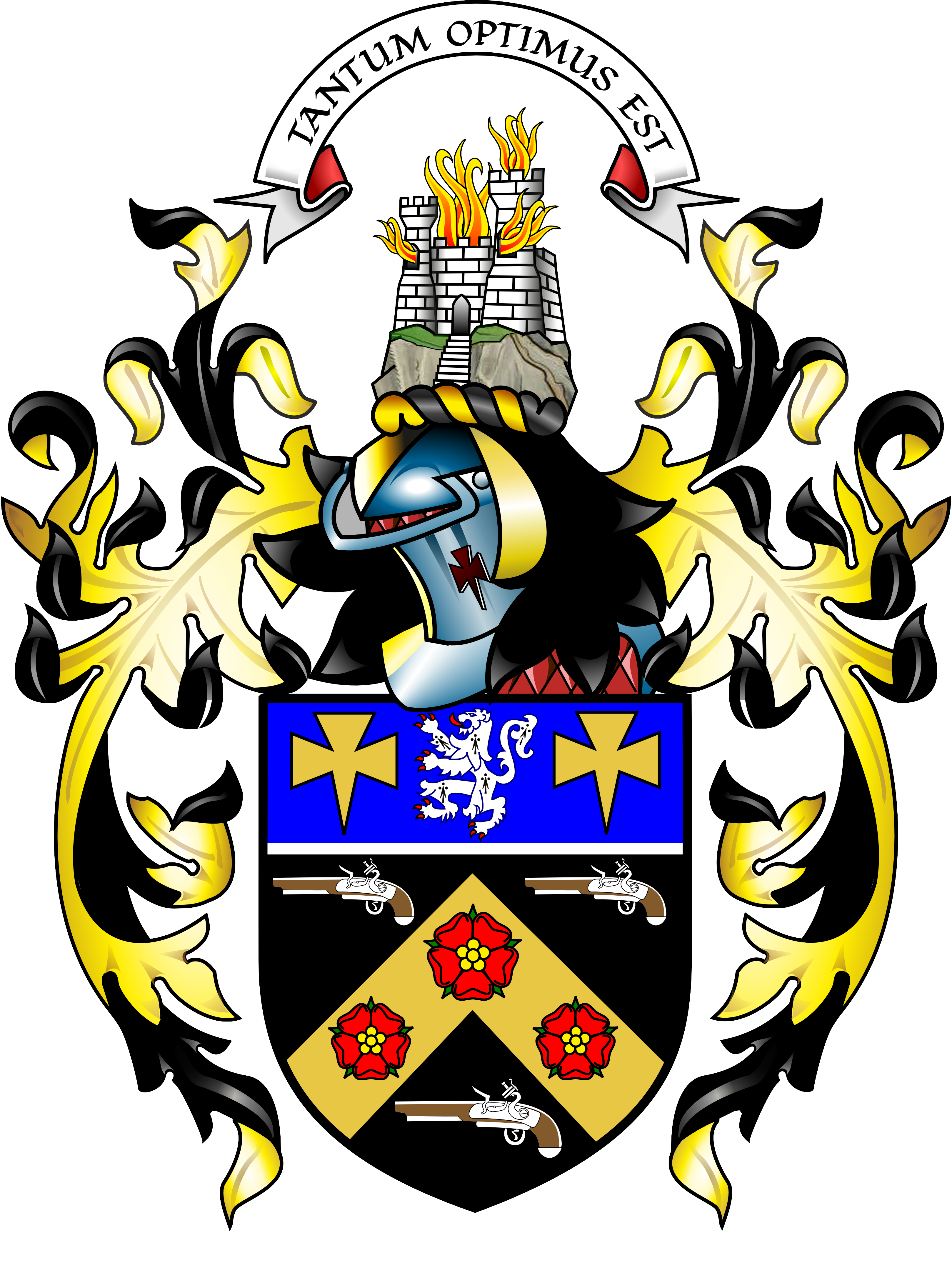
Five Armorial Traditions
The ancestral and structural sources that informed the design
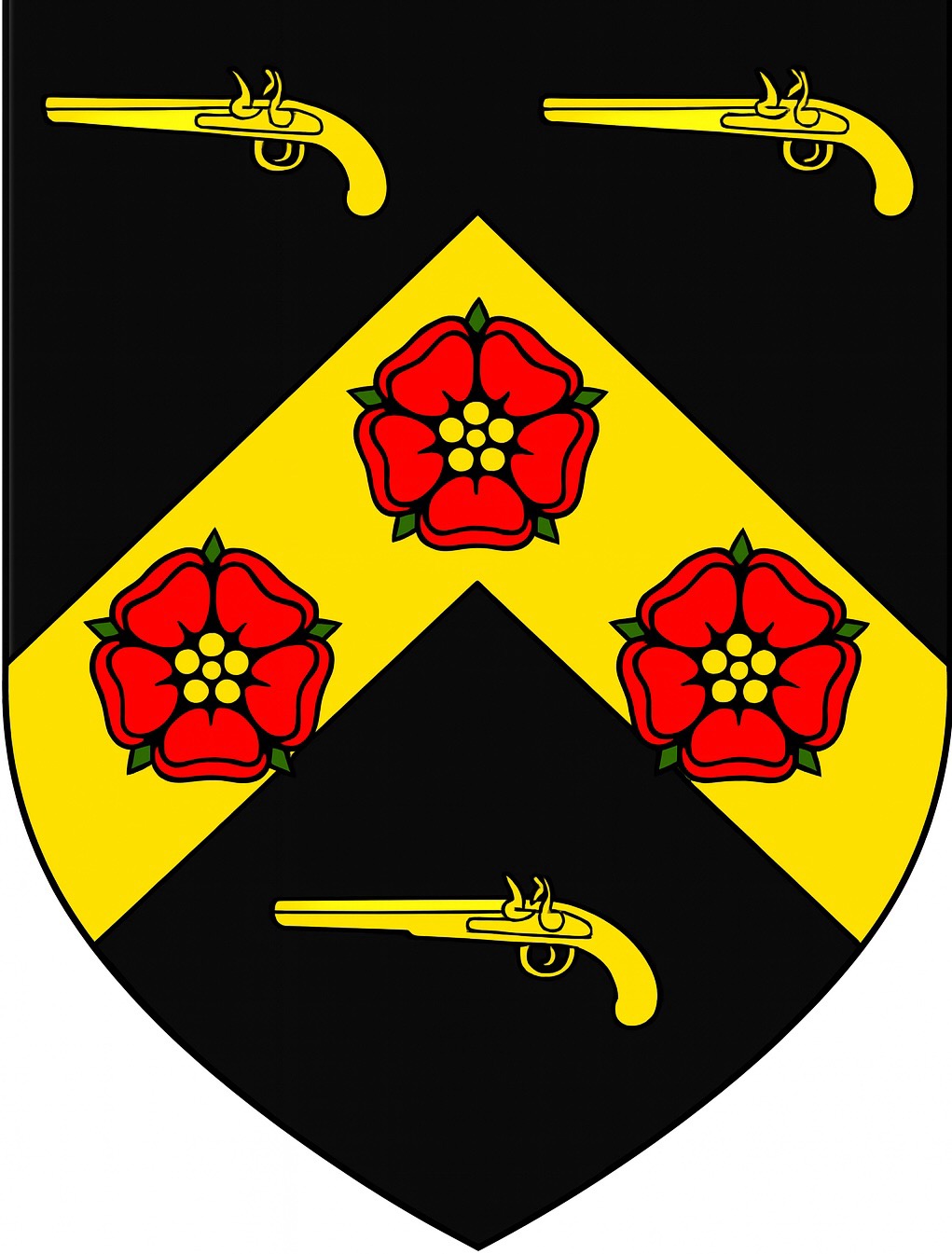
Hopking / Hopkin
Structural Foundation
Sable, on a chevron Or, between three ancient pistols, three roses Gules. Provided the structural foundation—field, chevron, pistols, and roses retained as principal elements. Used explicitly as surname association, not inheritance.
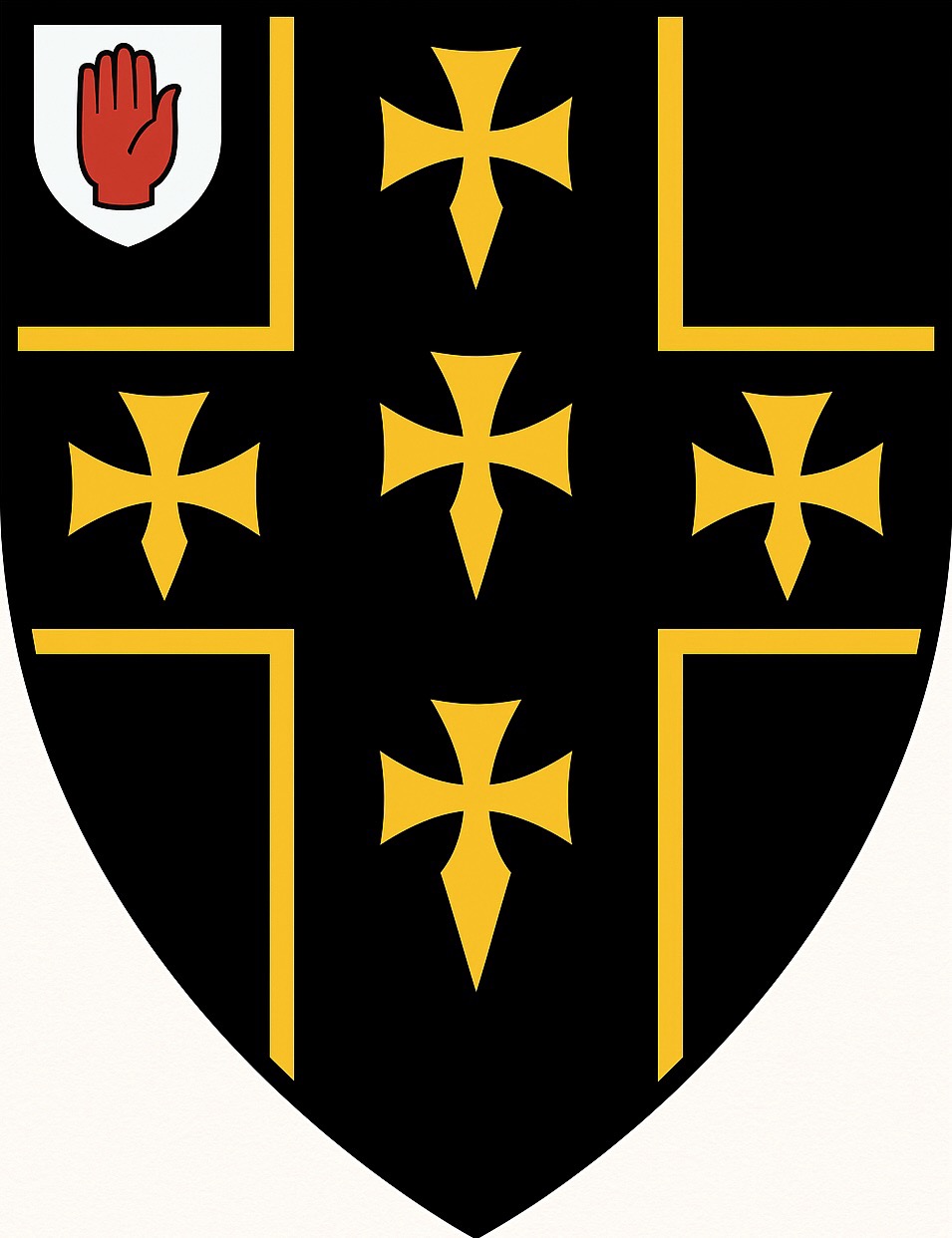
Walsham
Documented Ancestral Line
Sable, on a cross voided Or, five crosses patée fitchée of the last. Fully documented armigerous line. The crosses patée fitchée adopted as the principal Walsham reference, placed in the chief flanking the central charge.
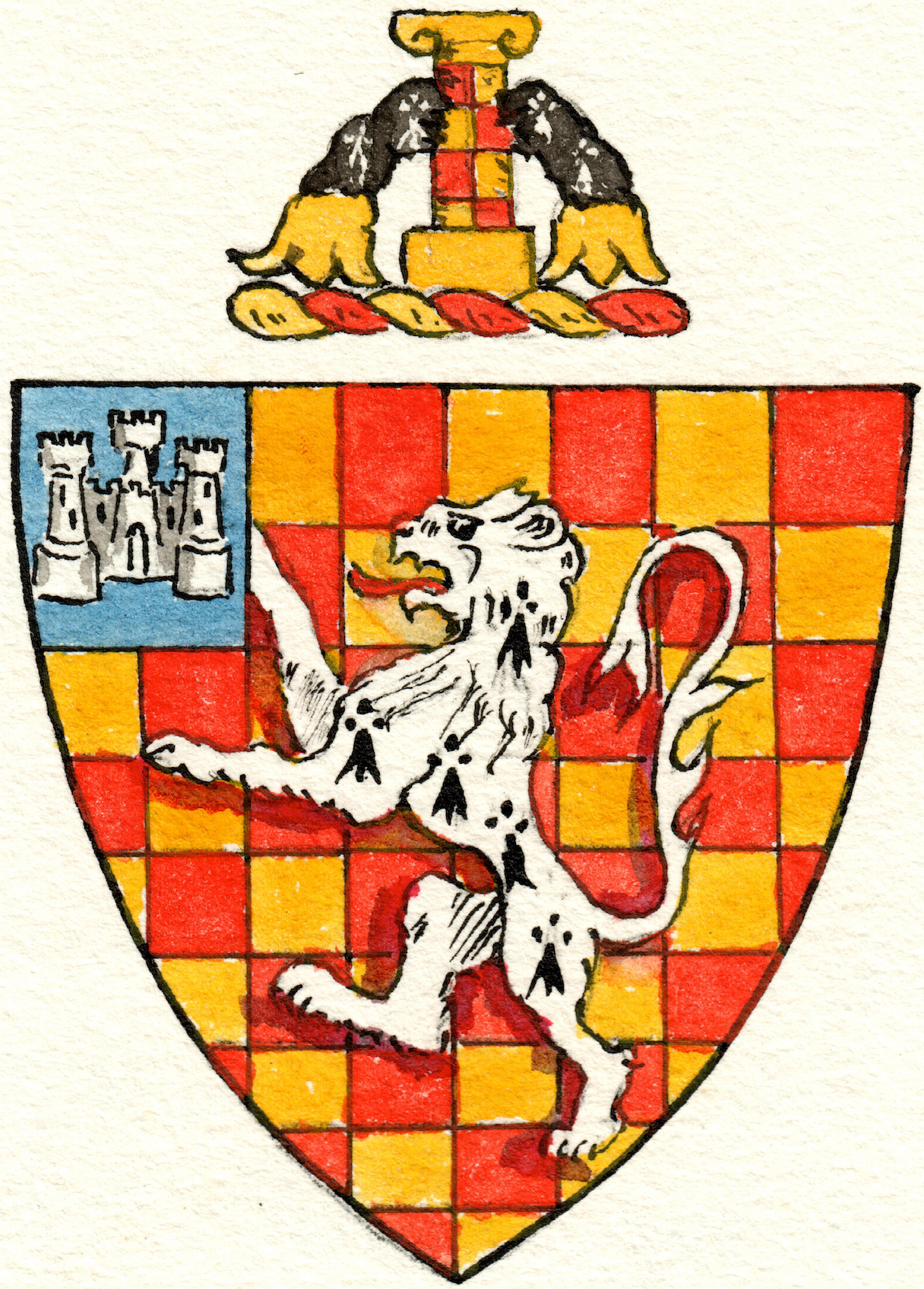
Scarlett
Documented Ancestral Line
Chequy Or and Gules, a lion rampant Ermine; on a canton Azure a castle triple-towered Argent. Senior armigerous line with continuous heraldic tradition. The lion rampant Ermine adopted as the central charge in the chief.
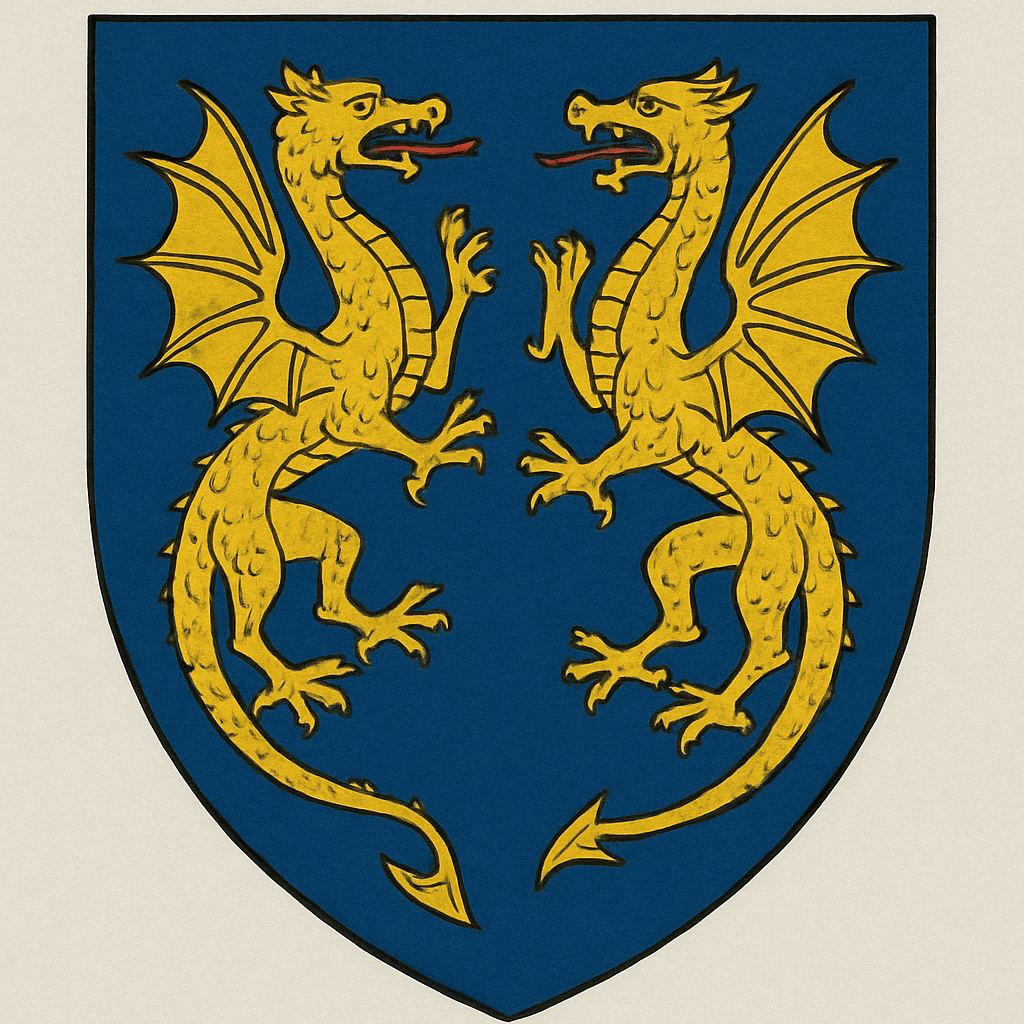
Fortin
Colour Reference
Azure, a horse forcené Argent, crined, unguled and membered Or. Attested arms with no demonstrated genealogical connection. Azure adopted as secondary tincture, used in the chief to reference Fortin armorial colour usage.
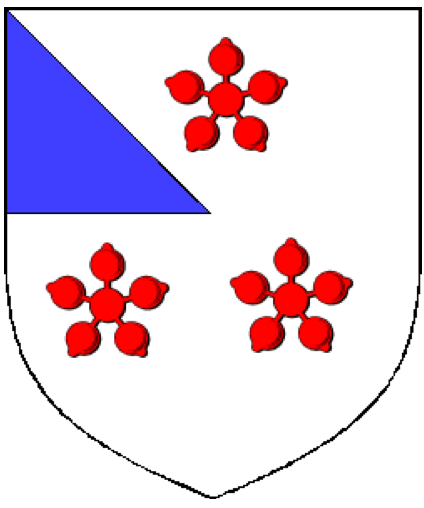
Chivers
Colour Reference
Attested arms with no demonstrated genealogical connection. Azure serves as a secondary tincture, informed by both Fortin and Chivers armorial colour usage in the design of the chief.
The Shield
The shield of Mark Richard Hopking bears the blazon:
Sable, on a chevron Or, between three ancient pistols of the last, three roses Gules; on a chief Azure in the lower part thereof a fillet Argent, between two crosses patée fitchée Or, a lion rampant Ermine.
This composition integrates five distinct armorial sources into a cohesive Scottish design. The field Sable and chevron Or with pistols and roses derive from the Hopkin structural tradition. The chief Azure contains the Walsham crosses patée fitchée and the Scarlett lion rampant Ermine, with the fillet Argent introduced by the Lord Lyon to separate Azure from Sable in compliance with the Laws of Arms.
The shared use of Sable in both Walsham and Hopkin arms facilitated their integration. Azure as a secondary tincture draws from Fortin and Chivers armorial colour usage, creating a harmonious composition that respects both Scottish heraldic law and the ancestral traditions it references.
The Crest: From Family Tradition to Formal Grant
The crest represents perhaps the most compelling narrative element of the achievement—a traditional family emblem used for generations, formally regularised through the Scottish grant.
Traditional Crest
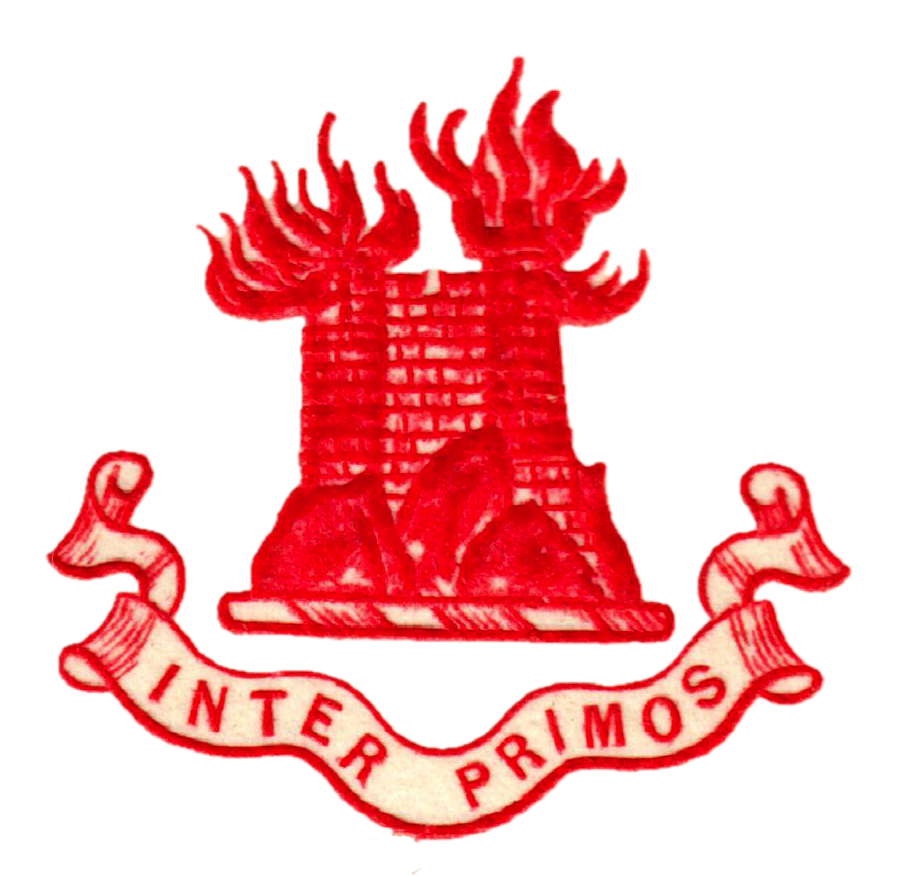
As traditionally used within the family for generations, notably on signet rings and personal items. Documentary evidence of use extends back five generations. Source unknown.
Granted Crest (2018)
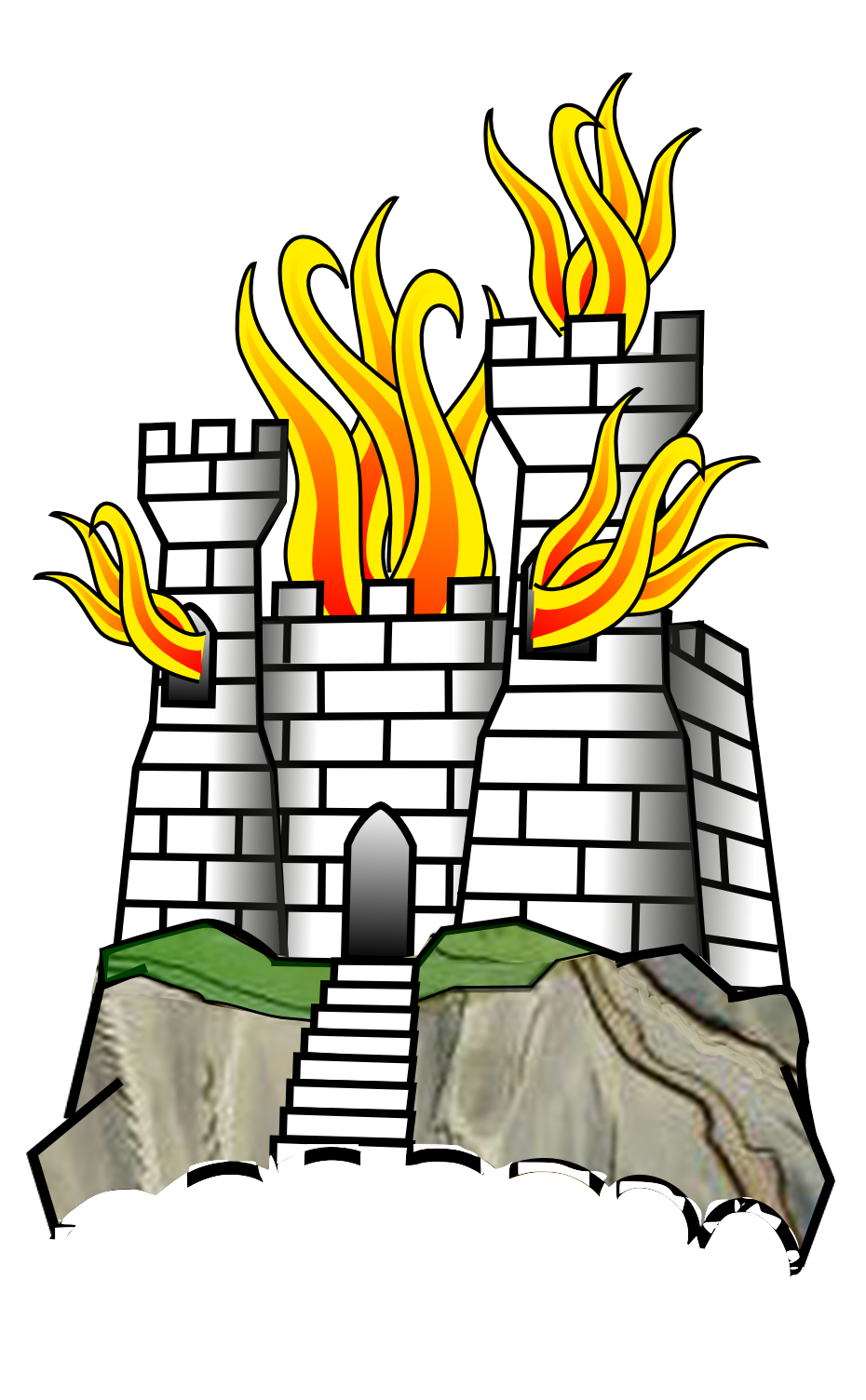
As formally granted and depicted in the full Scottish achievement of arms. The granted blazon represents a modernised and technically precise description of the crest as it had evolved in family usage.
The granted blazon—a double-turreted tower in prospect Argent, masoned Sable, flammant on a rock Proper—represents the crest as it had evolved in family usage by the time of the petition. No documentary source has been identified for its original adoption, and no claim is made to its antiquity or original grant.
An early family document from the nineteenth century, discovered only after the 2018 grant had been made, shows a slightly different blazon described as "A Flaming Fort" with the motto "Inter Primos" (Among the First). This historical variant provides intriguing context to the traditional family usage.
The Motto
The motto TANTUM OPTIMUS EST ("Only the Best") originated as a personal family expression specific to Mark Hopking, reflecting a long-standing characteristic rather than a historical motto inherited from armigerous ancestors. The phrase existed in English within the family and was Latinised for the heraldic grant.
The historical motto "Inter Primos" represents an intriguing parallel—both mottoes express themes of primacy and excellence, though adopted independently and at different times.
The Helm
In accordance with Scottish practice, the Letters Patent depict a helm befitting the petitioner's degree at the time of grant in 2018, when he did not yet hold a Scottish barony. At that time, the appropriate helm was that of an Esquire.
Following the later acquisition of the Barony of Balvill in 2025, the armiger is thereafter entitled, by custom, to depict a helm appropriate to that dignity in subsequent artistic renderings. The original grant remains unaltered, and no inconsistency arises between the juridical record and later representational usage.
The Arms as Granted
The arms, crest, motto, and pennon exist as a single juridical creation of the Court of the Lord Lyon. While informed by ancestry and tradition, their authority derives solely from the grant itself as recorded on page 90 of volume 93 of the Public Register of All Arms and Bearings in Scotland.
A full discussion of the genealogical evidence underlying the family lines referenced here is provided separately at genealogy.markhopking.co.uk.
Grant Details
- Granted to
- Mark Richard Hopking
- Granted by
- Court of the Lord Lyon
- Date of grant
- 2018
- Register
- Page 90, Volume 93
- Authority
- Public Register of All Arms and Bearings in Scotland
- Jurisdiction
- Scottish heraldic law
- Status
- Individual, heritable property
- Helm updated
- 2025 (after acquiring Barony of Balvill)
References
- Court of the Lord Lyon. Public Register of All Arms and Bearings in Scotland, Vol. 93. Edinburgh: Court of the Lord Lyon, p. 90.
- Lord Lyon Society. "Armorial". Retrieved 8 January 2026. https://lordlyonsociety.org.uk/armorial/
- The Peerage, Baronetage and Knightage of the British Empire, Part II. London, c.19th century, p. 676 (Walsham of Knill Court).
- "Walsham baronets." Wikipedia. https://en.wikipedia.org/wiki/Walsham_baronets
- Cracroft's Peerage. "Abinger, Baron (UK, 1835)". http://www.cracroftspeerage.co.uk/abinger1835.htm
- "Baron Abinger." Wikipedia. https://en.wikipedia.org/wiki/Baron_Abinger